
Sneha Jaiswal (Twitter | Instagram)
Robert Graves was 19 years old when he enlisted in the army, fresh out of boarding school, not too keen on attending university yet, so he chose to join the war instead and recalls many of those experiences in his memoir ‘Goodbye to All That’.
It would be surprising to meet an English Literature student who doesn’t know of Robert Graves, an acclaimed World War I poet, one of the first few to realistically write about the terrors of being in the trenches. Although, ‘Goodbye to All That’ begins with Graves first recalling his ‘earliest memories’, including his mother’s influence on him, and family vacations spent in Bavaria at his grandfather’s place. These first few pages are haphazard and difficult to read, as if going through someone’s fragmented memories, which is really the overall essence of this novel – it’s scattered with random incidents, with some leaving powerful enough impressions to wash out the disappointment from the unnecessary bits.
Before Graves progresses to his memories of war days, where he served with the which form the bulk of the memoir, he writes about his time at Charterhouse, a boarding school where he was often bullied, so he took up boxing to fight back. He candidly calls himself a “pseudo-homosexual” early on, describing how English schools were breeding grounds for inevitable attraction between the same sex. Of course, that was the early 1900s; modern critics and readers would label Graves a bisexual, since he had intense love affairs with both men and women, fathering multiple children.
“In English preparatory and public schools romance is necessarily homosexual. The opposite sex is despised and treated as something obscene. Many boys never recover from this perversion. For every one born homosexual, at least ten permanent pseudo-homosexuals are made by the public school system: nine of these ten as honourable caste and sentimental as I was.” – Robert Graves in Page 23 of ‘Goodbye to All That’ (Penguin Modern Classics edition).
Readers will find only some fleeting mentions of his crush on a junior boy at school and a rather dry account of his marriage to first wife Nancy Nicholson in ‘Goodbye to All That’. After the first few chapters on his school days, Graves begins to detail his World War I experience as a soldier. While the memoir may not match the raw intensity of some war poetry, it offers a poignant look at the chasm between patriotic idealism and personal despair in the trenches. His own idealism around war would slowly be eroded as he would witness comrade after comrade perishing in a war that never seemed to end.
Graves recounts how soldiers, gripped by fear and loneliness, would take their own lives, only for their deaths to be reframed back home as acts of heroism, sparing families the shame of knowing their sons would branded as ‘cowards’. One of the most ironically tragic moments in ‘Goodbye to All That’ is when Graves recounts pausing for a meal at camp, while in a nearby enclosure, a senior officer demonstrating how not to use a grenade accidentally sets it off, killing himself instantly. The reader gets a concrete sense of the absurdities of warfare, including the copious amount of blood and lives lost as meaningless collateral damage in the theater of war, even though the author doesn’t necessarily pour too many graphic details in this memoir.
“Goodbye to All That” was a fascinating read for me in parts because this is the first time I am reading the memoir of a World War I soldier, a famous poet at that. The language and prose, however, aren’t smooth and are probably too alien and colloquial from the early 1900s for foreign readers. Not just that, Robert Graves often simply keeps talking about random famous people he encountered during the war, including a very forgettable anecdote about briefly meeting someone from the royal family. His friendship with fellow poets Siegfried Sassoon and Wilfred Owen makes more sense, and Robert is full of praise for Sassoon’s war poetry and his increasingly anti-war stance. It’s made me want to add “Memoirs of a Fox-Hunting Man” to my ‘want to read’ list.
It’s clear from “Goodbye to All That” that Siegfried Sassoon was a major influence and inspiration to Robert Graves, although their friendship seems to fade after the war ends, and Graves doesn’t mention him too much. For a memoir over 350 pages long, it’s a curious mix of personal and impersonal anecdotes, making it hard for the reader to get a strong sense of Graves’ true personality. He is a curious, contradictory figure, extremely proud of his stint in the war, yet disillusioned by the politics of it all, passionately lamenting the price paid by common young soldiers (some as young as 14, it seems) for the egos of war generals. At times, it feels like Graves is performing an awkward balancing act, trying to be candidly passionate about views that might be seen as scandalous, while still steering clear of outright outrage or controversy.
“Since 1916, the fear of gas obsessed me: any unusual smell, even a sudden strong scent of flowers in a garden, was enough to send me trembling. And I couldn’t face the sound of heavy shelling now; the noise of a car back-firing would send me flat on my face, or running for cover.” – this is perhaps one of the most moving things I read in “Goodbye to All That”. One of the rarer snippets in the memoir describing the lasting trauma and psychological scars inflicted upon Robert Graves by the war.
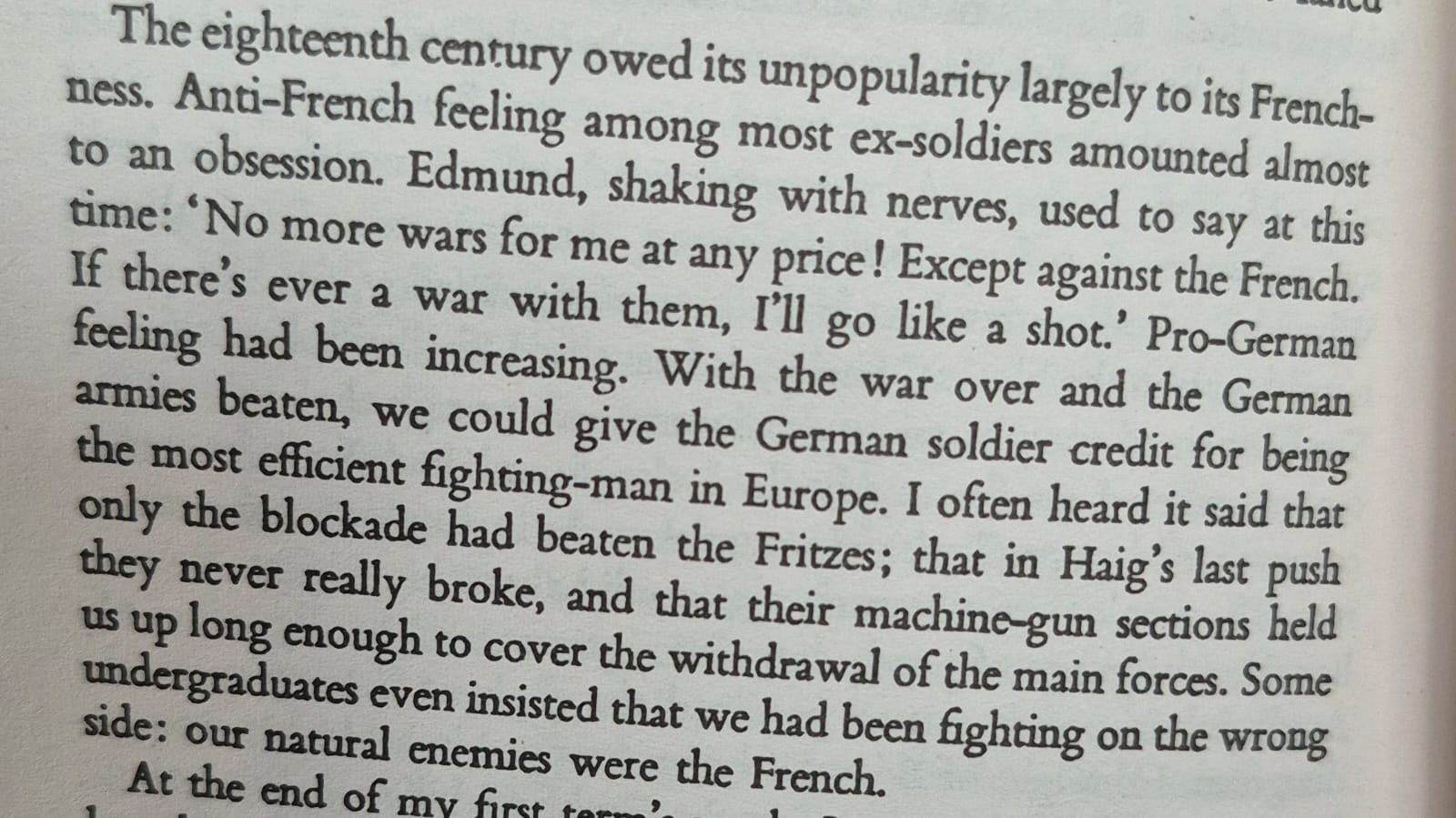
As a history enthusiast, the most amusing thing I learned from the book was the British hatred for the French, despite them being allies. Graves writes about how the average British soldier often despised their French peers more than their German enemies, a sentiment he mentions multiple times in Goodbye to All That, making it impossible to ignore. Sample what Graves says while expressing his disdain for 18th-century literature:
“The eighteenth century owed its unpopularity largely to its Frenchness. Anti-French feeling among most ex-soldiers amounted almost to an obsession. Edmund, shaking with nerves, used to say at this time: ‘No more wars for me at any price! Except against the French. If there’s ever a war with them, I’ll go like a shot.’ Pro-German feeling had been increasing. With the war over and the German armies beaten, we could give the German soldier credit for being the most efficient fighting-man in Europe.”
The last few chapters focus on Robert Graves finally leaving the trenches, trying his hand at running a grocery store with his wife Nancy, not too far from Oxford university, where he had studied English Language and Literature. The couple then moves to Egypt, after Robert gains himself a place to teach English abroad, a very short tryst. Writing about his short-lived teaching career in Egypt, Robert Graves abruptly ends the memoir, telling the reader that his life gets quite dramatic after he leaves Egypt, but those experiences are ‘unpublishable’. It’s essentially telling the reader “actually, my life is about to get spicier, and a lot more fascinating, but I have no interest in sharing those chapters with you.”
As the title “Goodbye to All That” suggests, the book focuses solely on Robert Graves’ wartime experiences and the years immediately after, ending around 1926. Just three years later, following the collapse of his marriage to Nancy and a deepening disillusionment with his homeland, Graves left England for good. “I vowed never to make England my home again,” he tells the reader.
If you, like me, haven’t read any World War I memoirs, ‘Goodbye to All That’ could be good place to start, even if it seems slightly all over the place.
Rating: 3.5 on 5 stars.
Read Next: Reviewing Mary Shelley’s Frankenstein in 2025
Also Read: Sirens Netflix Series Review (Short Audio Version below)