
Sneha Jaiswal (Twitter | Instagram) Click here for a short audio version
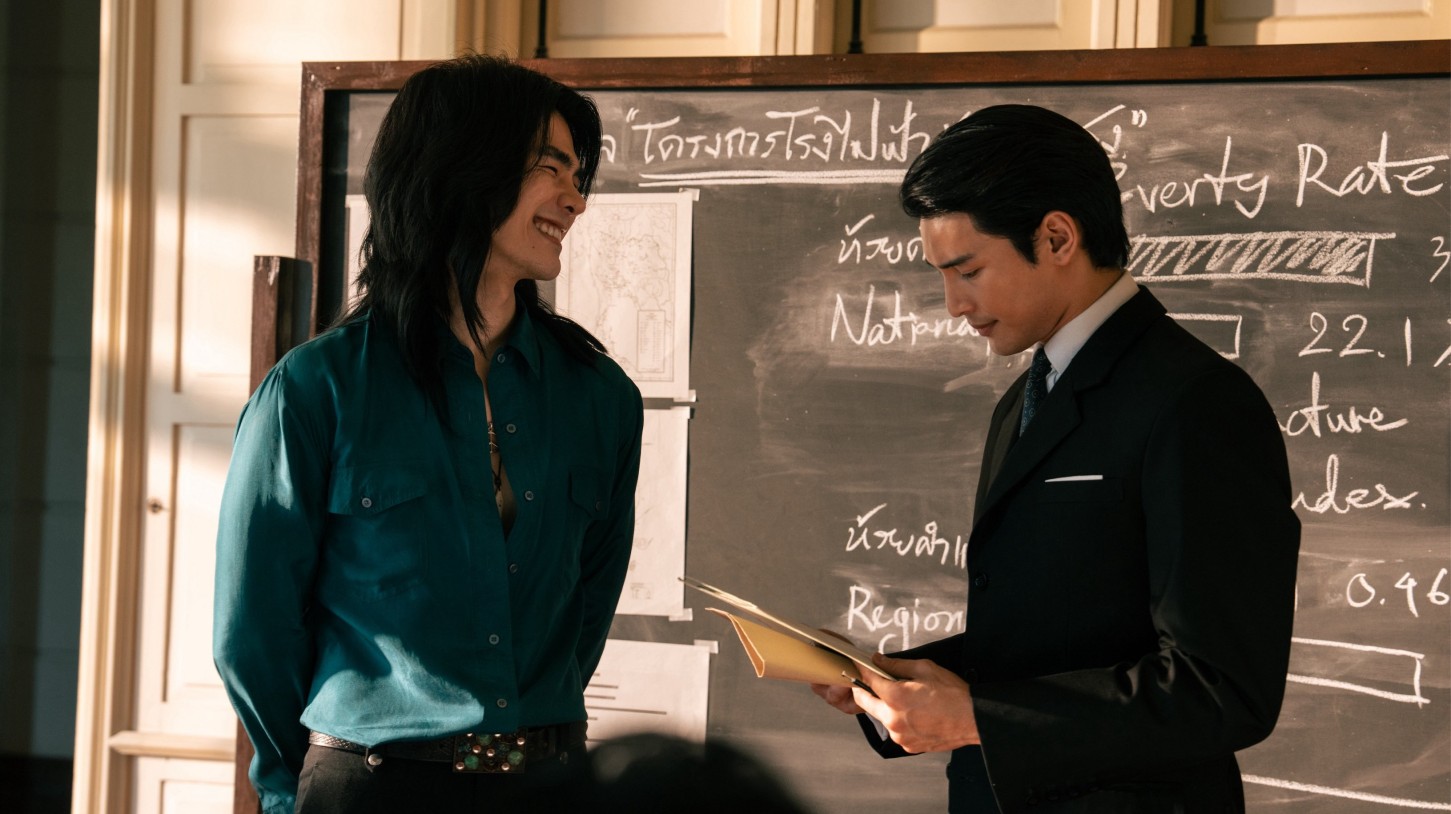
“Are you seriously sad because John Lennon quit the Beatles?” a mildly bewildered Trin, the protagonist of ‘Shine’ asks Thanwa, the other lead, as they stand hand in hand in a circle of flower-crowned hippies around a bonfire. It’s a comical scene, but it also highlights the stark divides in the realities of the show’s various characters.
Directed by Pond Krisda Witthayakhajorndet, and Ning Bhanbhassa Dhubthien, ‘Shine’ is a period drama set in 1969, starring ‘KinnPorsche’ stars Apo Nattawin Wattanagitiphat and Mile Phakphum Romsaithong as Trin and Thanwa respectively. Trin, an economist and adjunct professor, has returned from France determined to aid his country’s progress, while Thanwa is a blue-blooded brat and hippie, living in his own happy bubble of sex, love, drugs, and rock ’n’ roll. Their unexpected love story, set against Thailand’s political upheaval, drives the primary plot of the series.
The steamier romance in ‘Shine‘ belongs to Trin’s Uncle Krailert (Son Yuke Songpaisan) and Naran (Euro Yotsawat Tawapee), whose love story starts in print, dueling as pseudonymous music critics in a national newspaper. Their sharp exchanges quickly capture the public’s attention, playfully shown in scenes of people gleefully reading newspapers at their homes, coffee shops, and offices. When they secretly decide to meet at a private library, the reveal of their real identities only intensifies the attraction.

Krailert is a high-ranking military officer, and Naran an ambitious journalist, their forbidden romance is further tangled by the fact that Krailert is married, while Naran is investigating corrupt land deals that may implicate him. In flashbacks, we see how Dhevi (Kob Pimolrat Pisolyabutr) became Krailert’s wife, after her influential military father pressured him into the marriage, fully aware of his preference for men. Por Unnop Thongborisut plays Veera, Krailert’s faithful military sub-ordinate, silently in love with Dhevi.
Son Yuke Songpaisan is electric as Krailert, a morally grey figure torn between his public duties as a military officer and his secret queer life. Euro Yotsawat Tawapee’s Naran, by contrast, feels more like a stock journalist character, though he shines when voicing his column on music and matters of the heart. Their story begins as a battle of wits in public and becomes something far steamier in private, as Krailert’s library turns rivals, a decorated officer and a relentless reporter, into secret lovers.
Meanwhile, newcomer Peter Deriy, possibly the breakout star of ‘Shine’, plays Victor, a fiery student activist leader who constantly organizes headline-grabbing protests against the corrupt Thai government and military. Victor’s story ties back to the main plot as he attends one of Trin’s economics classes, where he challenges the professor’s privileged background, but over time, he also finds himself drawn to Trin.

It’s comedic to see Victor start out as the quintessential angry young man, all fire and fury against the corrupt regime, but the moment Cupid’s arrow hits, he’s suddenly soft-eyed and following Trin around like a lovestruck pup. When he senses sparks between Trin and the carefree Thanwa, his jealous glares are downright funny. The love triangle adds some laughs to ‘Shine’, with Trin’s older, dignified presence balancing it all as he kindly lets Victor down.
My biggest gripe with ‘Shine‘, and this might just be a personal peeve, is that Mile Phakphum Romsaithong feels miscast as the lead singer of a popular band. His portrayal of Thanwa is hit-and-miss: while he delivers the show’s biggest laughs as the childlike hippie, the more serious aspects of his character don’t land, and the supposed ‘rockstar’ persona never really comes through. In ‘KinnPorsche‘, his chemistry with Apo Nattawin Wattanagitiphat was sizzling, yet here the romantic blaze feels oddly lukewarm. Possibly also because the playful Thanwa never seems sincere, not even the rare times the character is being genuine.
But let’s talk about Apo Nattawin Wattanagitiphat now. He was last seen in a lead role as a Thai dancer in the period piece ‘Man Suang‘, where I noted, ironically, that while he looked stunning, he lacked the natural gait and grace of a professional artist. In ‘Shine‘, however, he is pitch-perfect: poised, charming, dashing, and convincing as an intellectual. If anything, his debates could have used sharper writing, but that shortfall isn’t on the actor.
Nok Sinjai Plengpanich appears as Moira, the elegant owner and hostess of ‘Grand Paradiso‘, a lavish hotel frequented by the town’s elite. The venue becomes the stage for several pivotal encounters, with Moira’s significance emerging fully in Shine’s climactic episode. Away from the glittering banquets, she is also spotted letting loose at the hippie parties hosted in Thanwa’s record store.
‘Shine’ is a well-crafted tale of love, desire, power, corruption, and student activism, with several scenes crafted for cinematic effect, existing in its own orbit, because some complex sub-plots are resolved too easily. The original soundtrack outshines many other elements of the series; ‘Am I in Love’ by Slot Machine is one of the most memorable numbers in the series, which plays like a romantic hit from the 1970s. Another song titled ‘Hold Your Hand’ is faster and fun too.
Episode seven brings some of the most tragic moments in ‘Shine’, blunting the impact of the climactic finale. A brief time skip at the end offers viewers clearer closure on the fates of the main characters. A cruel twist reframes one supporting character in an unsettling way, strange at first, but also a sharp reminder of how irrationally obsessive people can become in the name of love.
‘Shine’ closes on a surprisingly romantic note for some, while others are left with devastating grief. The ending threads feel a bit contrived and the writing stumbles, yet despite its flaws, this retro romance remains worth a one-time watch.
Rating: 7.5 on 10. Watch ‘Shine’ on WeTV.
Read Next: Kill to Love Review: Zhang Zhe Xu, Mi Jin Burn in Doomed Love
Also Read: The Ba***ds of Bollywood Series Review (Audio Version Below)
Hello Sneha Jaiswal, I just read your review, and before you read this comment, I’d like to ask you to please consider the cultural differences between us (I’m Brazilian). I’m not here with the intention of offending you.
I believe there was a misunderstanding regarding Mile’s character, he’s not a rock star; he’s an irresponsible hippie who doesn’t know how to deal with his traumas. His being in a band is simply part of his personality; it doesn’t define who he is. He could just as well be a supermarket cashier, a tango dancer, or anything else, and it wouldn’t make a difference.
Continuing from my previous comment: The soundtrack is a show in itself and deserves a standing ovation; the cinematography, costume design, set composition, and screenplay achieved something often forgotten in big productions, they maintained coherence, with everything carefully thought out in detail.
I’ll keep following your work because it’s truly interesting to see things from other people’s perspectives.