

‘CUT!’
That’s sometimes the only word that brings protagonists Zhen Xin and Zhang Zhun back to reality. ‘Deep In’ follows two actors who gradually blur the line between their on-screen characters and real selves while playing romantic leads in an intense psychological queer drama.
Directed by Liu Jun Hao, the 12-episode series is based on Tong Zi’s Chinese danmei novel Deep in the Act and marks the acting debut of Ollie (contestant in ‘Boys Planet‘ and winner of ‘Asia Super Young’) and Shu Yuan. Ollie plays Zhen Xin, a popular, award-winning young actor, while Shu Yuan stars as struggling stunt double Zhang Zhun, whose life changes after landing the lead role opposite him. The film they’re shooting is treated almost like a parallel storyline, allowing us to follow both their on-screen romance and their growing attraction behind the cameras.
Within the film, Ollie plays psychiatrist Fang Chi, while Shu Yuan’s character portrays Gao Zhun, his patient with severe mental health struggles and a deeply traumatic past. What’s darkly hilarious is just how meta everything becomes. The psychiatrist-patient relationship is wildly unethical, deeply twisted, and not exactly grounded in real-world psychology.
Also Read: Kill to Love Review: Zhang Zhe Xu, Mi Jin Burn in Doomed Love
While Shang Chi himself calls his methods ‘controversial’, even the characters working on the film begin questioning what kind of bizarre therapy they’re depicting. In Episode 4 of ‘Deep In’, one amused character even turns to the director and quips, “What kind of therapy is this? The writer is bold.” It’s a wink from director Liu Jun Hao, who basically indicates he is happy embracing the show’s fan-fiction-like melodrama and is most definitely not trying to be clinically accurate in any way.
The opening seconds of Deep In are fantastic. It begins with an intimate scene of the protagonists lying in bed, whispering to one another, and sharing lingering kisses. At first, we see only their faces. Then the camera slowly begins to pull back, revealing their bodies, followed by cameras, microphones, and finally someone shouting, “Cut!”.
Suddenly, the two men separate. Every trace of passion vanishes from their faces, and they behave like exhausted strangers at work. They’re clearly not that deep into their roles after all. So what’s really going on? It’s an irresistible hook, elevated further by a memorably catchy opening track that, strangely enough, never plays again. The music in that one minute cleverly captures the central idea of the series: that what you’re seeing isn’t necessarily what’s really happening.
The film within the series is exaggeratedly melodramatic and often takes up far more screen time than it needs to, so viewers primarily invested in Zhen Xin and Zhang Zhun’s romance may find Deep In‘s pacing rather frustrating. Besides, it’s their off-screen relationship that feels far more believable than the increasingly problematic psychiatrist-patient dynamic. There’s plenty of drama in their real life. Both actors already have girlfriends, but after being made to spend two weeks sharing a hotel suite to build chemistry, Zhen Xin begins desiring Zhang Zhun, while the latter slowly finds himself questioning his own feelings too.
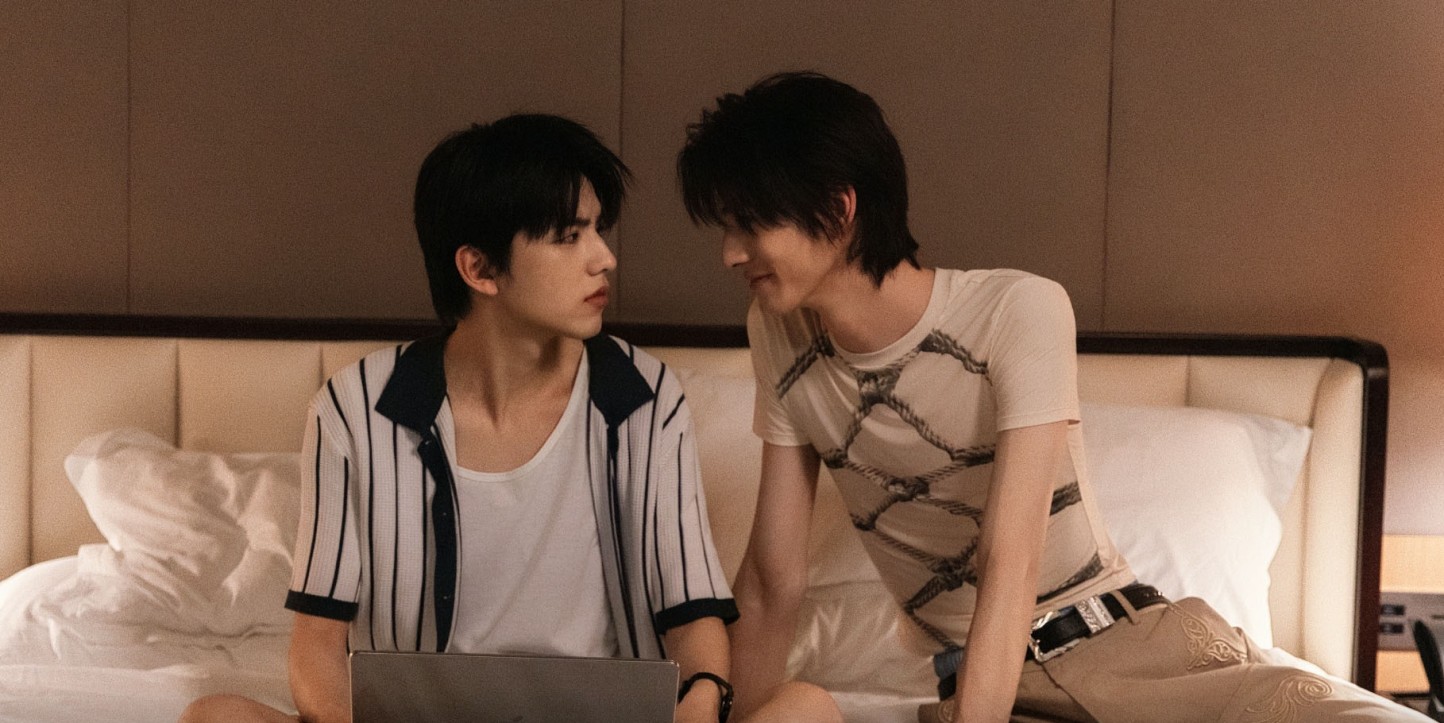
Zhang Zhun keeps telling himself he’s fallen victim to method acting, that all those intimate rehearsals and love scenes have messed up his head. Zhen Xin, on the other hand, has no such doubts. Once the cameras stop rolling, he has no intention of leaving his feelings behind on set. That’s the question Deep In keeps asking: is this the real thing, or just an occupational hazard of pretending to be in love for days on end?
Ollie is the breakout star of Deep In. Although he looks far too young to convincingly play psychiatrist Fang Chi and would’ve been more apt for a High-School romance. Age aside, he portrays both the arrogantly flirtatious Zhen Xin and the cold, aloof, morally grey Fang Chi with a confidence that belies his years. Part of the credit also goes to his voice actor, whose deeper, commanding performance lends the character an extra layer of authority.
Shu Yuan, on the other hand, is gorgeous as Zhang Zhun, making the premise of a superstar actor falling head over heels for his new co-star completely believable. While his stiff body language works well for Gao Zhun, the emotionally scarred patient, it feels less convincing once you remember Zhang Zhun is supposed to be a seasoned stunt double. Some of his awkward body-language could also be because of the often bizarre over-the-top wardrobe the stylists make him wear through the show.
The chemistry between the leads swings between sexy-steamy and occasionally awkward. Together they look like they’ve stepped straight off the cover of a manhua. Shu Yuan perfectly fits the archetypal submissive BL protagonist, yet Deep In cleverly gives him two very different dynamics to play. As Zhang Zhun, he starts off as the shy, vulnerable newcomer, leaving Zhen Xin to take charge. As Gao Zhun, he gets to play the seducer instead, making the contrast between the two roles amusing. Both characters are often left teary-eyed, and I couldn’t help but think he’s exactly the sort of guy Sheng Shao You, the ‘alpha’ lead from ABO Desire, would instantly fall for.

Interestingly, unlike many BL dramas, Deep In doesn’t reduce its girlfriends to one-dimensional, jealous stereotypes. Zhang Zhun’s girlfriend is strangely underused, appearing in just a single episode before quietly fading into the background. Perhaps that’s the director’s way of showing her gradual irrelevance in his life. Bai Yi Ru, meanwhile, plays Zhen Xin’s girlfriend, a fellow actor who’s far too busy with her own career to get swept up in the relationship drama. She eventually bows out with surprising grace, but not before extracting her pound of flesh as compensation.
The thing about Deep In is… I could probably make an entire “10 Things Wrong With This Show” video about it. At the same time, I’d also have to admit it’s quite entertaining is large parts. It’s not quite a case of “so bad, it’s good.” It’s more: “yes, I can see all the flaws… but I still couldn’t stop watching.” Beneath all the melodrama, questionable therapy, and occasional cringe lies an addictive romance with a pretty good soundtrack that keeps you interested until the end.
By Episode 12, the emotional conflict reaches its peak with heartbreak, misunderstandings, and a finale that’s gloriously cheesy and would never happen in real life. At least not in China (IYKYK). If you’re a danmei fan who enjoys a few red flags, a dash of toxicity, and emotionally messy romances, or if you’ve enjoyed Revenged Love, My Stand-In, or the recent Double Helix, there’s a very good chance you would want to binge-watch Deep In too.
Watch ‘Deep in’ on Viki or GagaOOLala.
Find the writer on Twitter | Instagram
Read Next: ‘Spider-Man: Brand New Day’ Review: The Big Crowd-Pleaser of 2026 (Audio Below)
